Operationalising Trustworthy AI: How NHS Greater Glasgow & Clyde is randomising an entire Emergency Department, one week at a time, to test AI

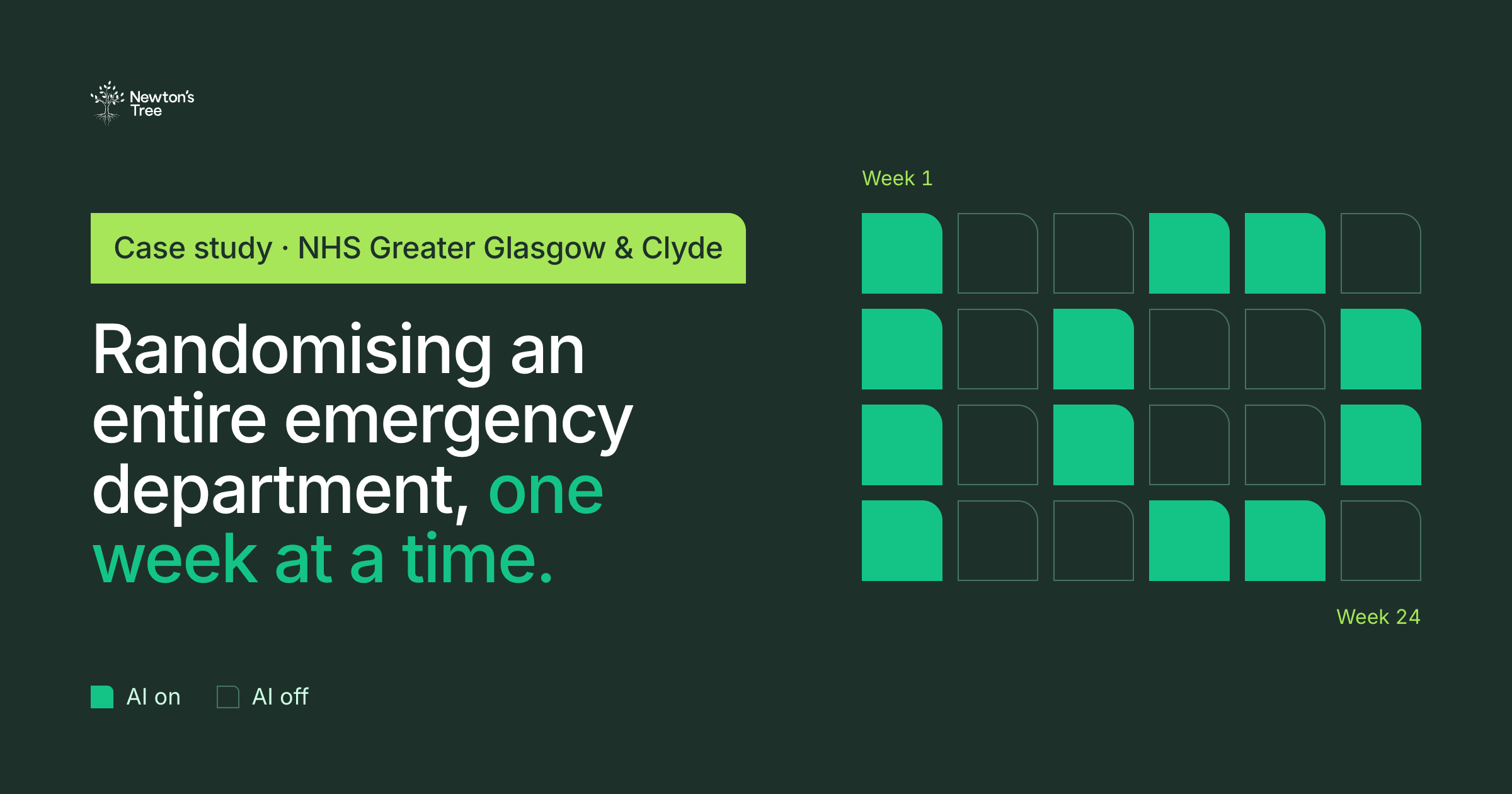
NHS Greater Glasgow & Clyde (NHS GGC) is using Newton's Tree orchestration and deployment Platform to deliver SEARCH-ED, a prospective clinical effectiveness trial that switches an AI-CXR application on and off across an entire Emergency Department (ED) in randomised one-week blocks, generating the evidence NHS GGC needs to decide whether the AI application should be adopted more widely.
NHS Greater Glasgow & Clyde (NHS GGC) is using the Newton's Tree orchestration and deployment platform to deliver SEARCH-ED, a prospective clinical effectiveness trial that switches an AI-CXR application on and off across an entire Emergency Department (ED) in randomised one-week blocks, generating the evidence NHS GGC needs to decide whether the AI application should be adopted more widely.

‍

Context

In order to inform a national decision on the impact of an AI solution before scaling across NHS Scotland, NHS GGC wanted robust, real-world evidence on whether an AI clinical decision support tool improves early diagnosis when deployed in a busy emergency department. The tool under evaluation is a CE-marked CXR application, which flags CXR features associated with heart failure, COPD and lung cancer. 

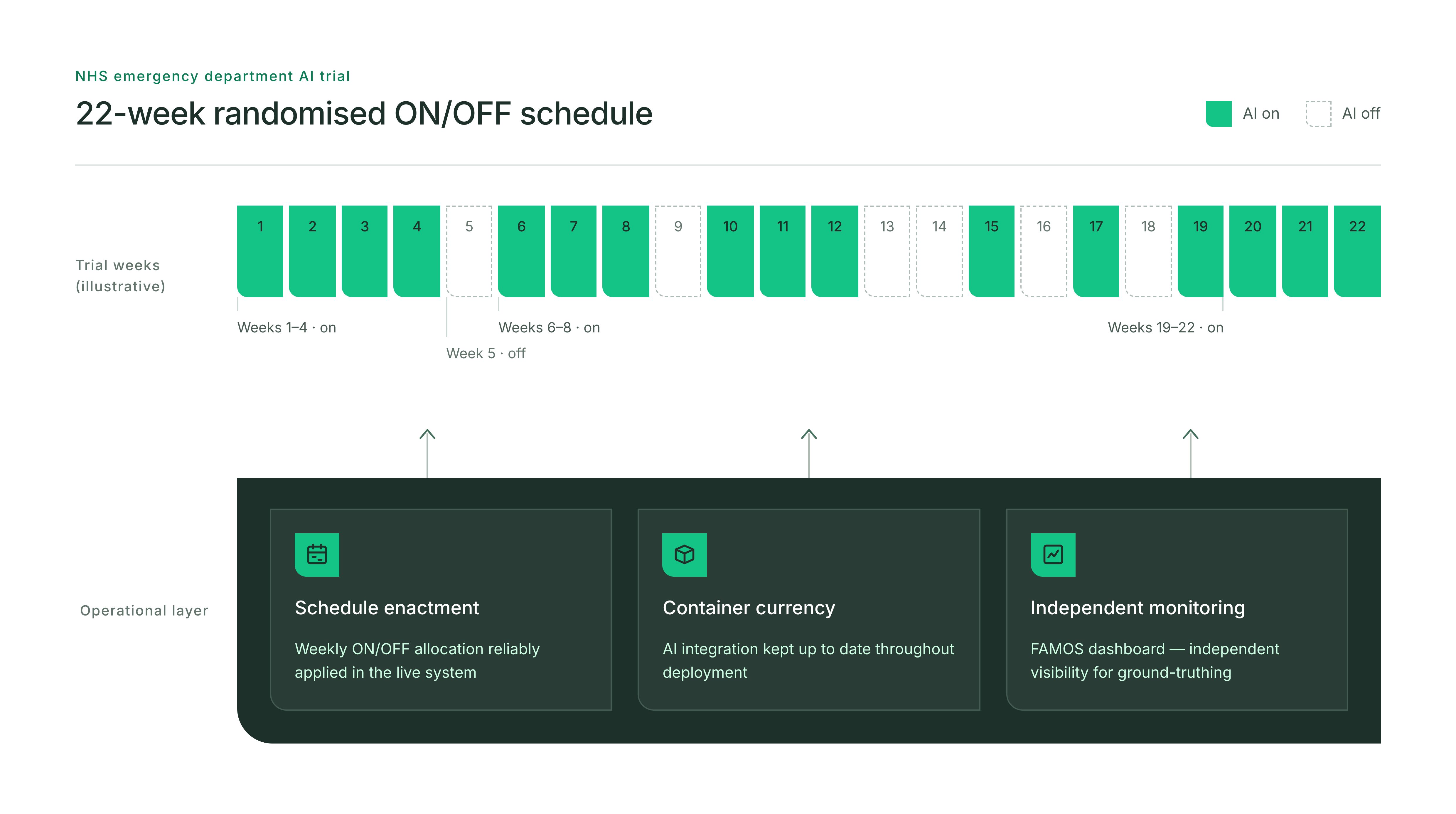
The AI deployment offers a unique opportunity to develop robust real world evidence. In this study, the AI result shown back to the clinician is switched ON or OFF for the whole department at once, in one-week blocks allocated by computer-generated randomisation. 
“On paper, switching the AI on and off for the whole department on randomised weeks is a simple way to generate real-world evidence, with clinicians contributing to both arms of the trial. It’s a design we had been wanting to try for a while, but logistically - and especially within an ED department – it requires platform infrastructure. Working with Newton’s Tree on the operational layer is what made this innovative trial design possible.”
‍
– Prof David Lowe, Clinical Director Innovation University of Glasgow, Emergency Consultant at Queen Elizabeth University Hospital, Glasgow

Challenge

While shadow mode reliably establishes the baseline, the primary technical challenge lies in trial execution. It is critical that AI insights going back into the PACS system are verifiably ON or OFF for exact seven-day blocks across thousands of chest X-rays, fully integrated within an uncompromised live clinical workflow.

The operational layer must be robust, safe, and secure. It must link to the hospital’s RIS and PACS systems, as well as extract data, and accommodate bug fixes and updates to the AI application, to maintain continuous performance throughout the study, without altering the clinical findings.  Separately, the research team needs an independent record of the findings produced by the AI application each week.

‍

Approach

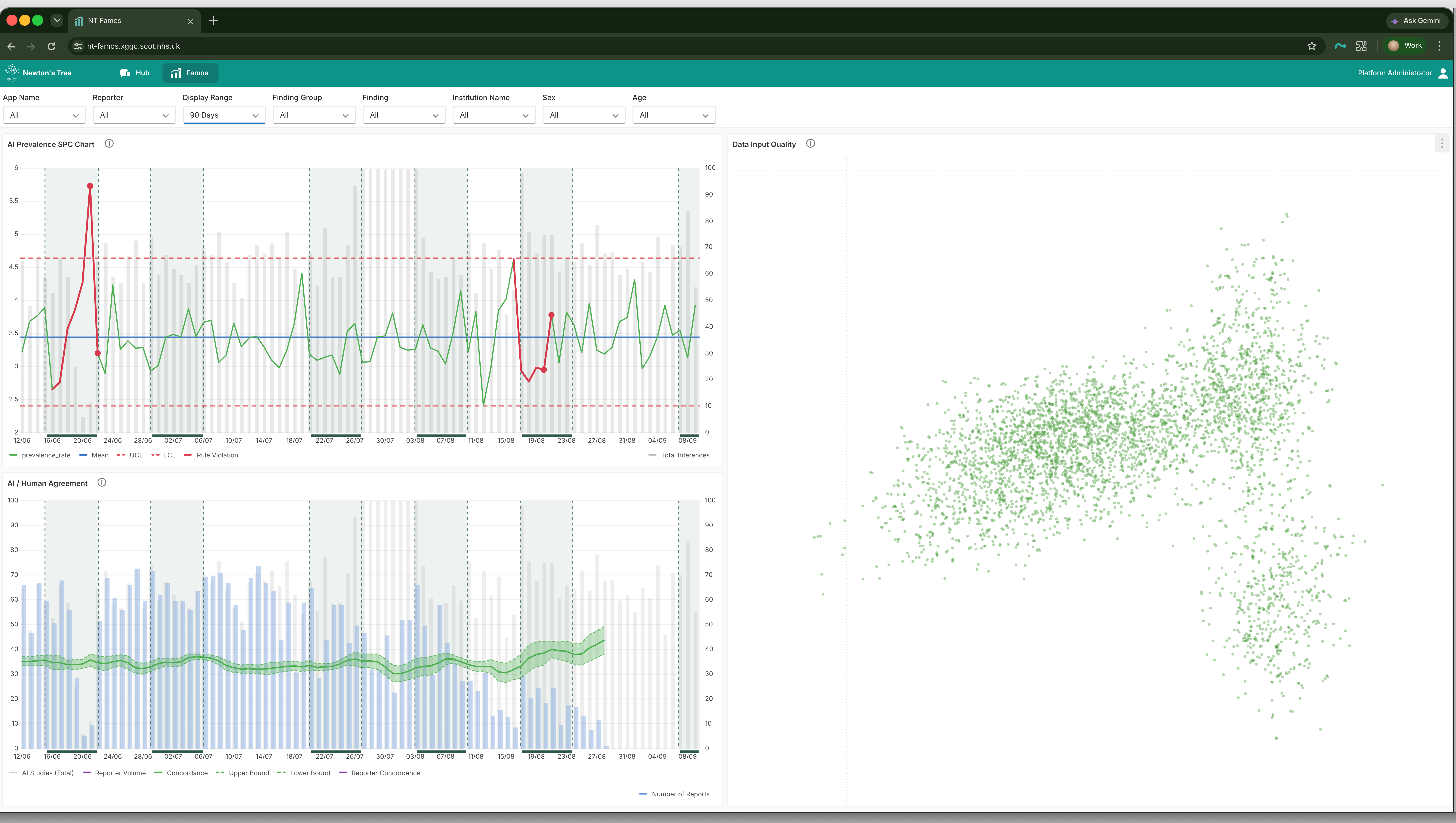
Newton's Tree set up the trial's technical infrastructure and took ownership of the operational layer beneath the methodological and statistical design. Ahead of the trial, this began with running the AI application in shadow mode to establish a baseline. From there, Newton’s Tree implements the weekly randomisation schedule, ensuring the statistician's computer-generated ON/OFF allocation is reliably enacted in the live environment; manages container updates for the AI application integration across the deployment; and enables independent monitoring via Newton's Tree's Federated AI Monitoring Service (FAMOS).

The effect is to separate the trial's statistical design from its operational delivery, so the study team's effort goes into ground-truthing and evaluating clinical impact, rather than manual operationalisation of the workflow.
Where the trial stands

  • Weekly on/off randomisation live: the schedule has been operating across the Queen Elizabeth University Hospital Emergency Department since the trial went live, with each block switched to the statistician's allocation without manual intervention.
  • Integration maintained through deployment: the CXR container has been kept current in the live PACS/RIS environment throughout.
  • Independent monitoring in place: FAMOS is live and in use, giving the study independent visibility of AI outputs.
  • Recruitment underway, results pending: the clinical effectiveness study is now running via the Newton’s Tree Platform. Clinical, diagnostic and cost-effectiveness results are expected once the deployment and 3-month follow-up are complete.

‍

Implications

A randomised cross-over study is an increasingly attractive way to evaluate AI clinical decision support. But the robustness of the trial and its outputs are only as good as its operational delivery - the AI has to genuinely switch state on a randomised schedule, on a maintained container, under independent monitoring. Before the crossover trial began, running the AI in shadow mode let NHS GGC establish a baseline, so that the results can be measured against a genuine “before”. That operational layer is what turns a well-designed trial into trustworthy evidence - and it is the layer Newton's Tree provides, regardless of which AI vendor or clinical target sits on top.

‍

Acknowledgements

SEARCH-ED is sponsored by NHS Greater Glasgow and Clyde (NHSGGC), with the project delivered through the West of Scotland Innovation Hub (WoSIH). It is supported by Harrison.ai, with funding from AstraZeneca and academic partnership from the University of Glasgow’s Health Innovation & Technology Lab (HITLab). 

With thanks to the following for their contributions to the trial: Dr Katriona Brooksbank - WoSIH Innovation Lead, NHSGGC; Dr Dervla Carroll – Senior Clinical Innovation Fellow, University of Glasgow; Prof Chris Carlin – Respiratory Consultant, West of Scotland Innovation Lead, NHSGGC; and Prof David Lowe - Clinical Director Innovation, University of Glasgow; Emergency Consultant, Queen Elizabeth University Hospital, Glasgow.

NEWS
November 9, 2026

Operationalising Trustworthy AI: How NHS Greater Glasgow & Clyde is randomising an entire Emergency Department, one week at a time, to test AI

NHS Greater Glasgow & Clyde (NHS GGC) is using the Newton's Tree orchestration and deployment platform to deliver SEARCH-ED, a prospective clinical effectiveness trial that switches an AI-CXR application on and off across an entire Emergency Department (ED) in randomised one-week blocks, generating the evidence NHS GGC needs to decide whether the AI application should be adopted more widely.

‍

Context

In order to inform a national decision on the impact of an AI solution before scaling across NHS Scotland, NHS GGC wanted robust, real-world evidence on whether an AI clinical decision support tool improves early diagnosis when deployed in a busy emergency department. The tool under evaluation is a CE-marked CXR application, which flags CXR features associated with heart failure, COPD and lung cancer. 

The AI deployment offers a unique opportunity to develop robust real world evidence. In this study, the AI result shown back to the clinician is switched ON or OFF for the whole department at once, in one-week blocks allocated by computer-generated randomisation. 

“On paper, switching the AI on and off for the whole department on randomised weeks is a simple way to generate real-world evidence, with clinicians contributing to both arms of the trial. It’s a design we had been wanting to try for a while, but logistically - and especially within an ED department – it requires platform infrastructure. Working with Newton’s Tree on the operational layer is what made this innovative trial design possible.”
‍
– Prof David Lowe, Clinical Director Innovation University of Glasgow, Emergency Consultant at Queen Elizabeth University Hospital, Glasgow

Challenge

While shadow mode reliably establishes the baseline, the primary technical challenge lies in trial execution. It is critical that AI insights going back into the PACS system are verifiably ON or OFF for exact seven-day blocks across thousands of chest X-rays, fully integrated within an uncompromised live clinical workflow.

The operational layer must be robust, safe, and secure. It must link to the hospital’s RIS and PACS systems, as well as extract data, and accommodate bug fixes and updates to the AI application, to maintain continuous performance throughout the study, without altering the clinical findings.  Separately, the research team needs an independent record of the findings produced by the AI application each week.

‍

Approach

Newton's Tree set up the trial's technical infrastructure and took ownership of the operational layer beneath the methodological and statistical design. Ahead of the trial, this began with running the AI application in shadow mode to establish a baseline. From there, Newton’s Tree implements the weekly randomisation schedule, ensuring the statistician's computer-generated ON/OFF allocation is reliably enacted in the live environment; manages container updates for the AI application integration across the deployment; and enables independent monitoring via Newton's Tree's Federated AI Monitoring Service (FAMOS).

The effect is to separate the trial's statistical design from its operational delivery, so the study team's effort goes into ground-truthing and evaluating clinical impact, rather than manual operationalisation of the workflow.

Where the trial stands

  • Weekly on/off randomisation live: the schedule has been operating across the Queen Elizabeth University Hospital Emergency Department since the trial went live, with each block switched to the statistician's allocation without manual intervention.
  • Integration maintained through deployment: the CXR container has been kept current in the live PACS/RIS environment throughout.
  • Independent monitoring in place: FAMOS is live and in use, giving the study independent visibility of AI outputs.
  • Recruitment underway, results pending: the clinical effectiveness study is now running via the Newton’s Tree Platform. Clinical, diagnostic and cost-effectiveness results are expected once the deployment and 3-month follow-up are complete.

‍

Implications

A randomised cross-over study is an increasingly attractive way to evaluate AI clinical decision support. But the robustness of the trial and its outputs are only as good as its operational delivery - the AI has to genuinely switch state on a randomised schedule, on a maintained container, under independent monitoring. Before the crossover trial began, running the AI in shadow mode let NHS GGC establish a baseline, so that the results can be measured against a genuine “before”. That operational layer is what turns a well-designed trial into trustworthy evidence - and it is the layer Newton's Tree provides, regardless of which AI vendor or clinical target sits on top.

‍

Acknowledgements

SEARCH-ED is sponsored by NHS Greater Glasgow and Clyde (NHSGGC), with the project delivered through the West of Scotland Innovation Hub (WoSIH). It is supported by Harrison.ai, with funding from AstraZeneca and academic partnership from the University of Glasgow’s Health Innovation & Technology Lab (HITLab). 

With thanks to the following for their contributions to the trial: Dr Katriona Brooksbank - WoSIH Innovation Lead, NHSGGC; Dr Dervla Carroll – Senior Clinical Innovation Fellow, University of Glasgow; Prof Chris Carlin – Respiratory Consultant, West of Scotland Innovation Lead, NHSGGC; and Prof David Lowe - Clinical Director Innovation, University of Glasgow; Emergency Consultant, Queen Elizabeth University Hospital, Glasgow.