West Midlands to Lead National Project to Monitor AI Performance in NHS Care

SENTINEL-AI will develop a framework to monitor AI performance across NHS organisations, with Newton's Tree providing the technical platform and expertise to deploy, integrate, monitor and evaluate AI technologies.

The West Midlands Secure Data Environment (SDE), hosted by University Hospitals Birmingham (UHB), will lead a major new national project to ensure artificial intelligence (AI) technologies continue to perform safely, effectively and fairly when used in NHS patient care.

Supported by the Health Data Research Service (HDRS), the project, known as SENTINEL-AI, will develop a framework to monitor AI performance across NHS organisations, helping to ensure these technologies deliver consistent benefits for patients while keeping their data securely within the NHS.

Newton's Tree is proud to be part of the collaboration delivering SENTINEL-AI.

‍

Why ongoing monitoring matters

It is vital to ensure that the performance of AI technologies in healthcare is always appropriately monitored, particularly where they are introduced into clinical practice. AI systems can perform differently across hospitals, patient populations and clinical pathways, making ongoing evaluation essential to ensure they remain safe, effective and equitable.

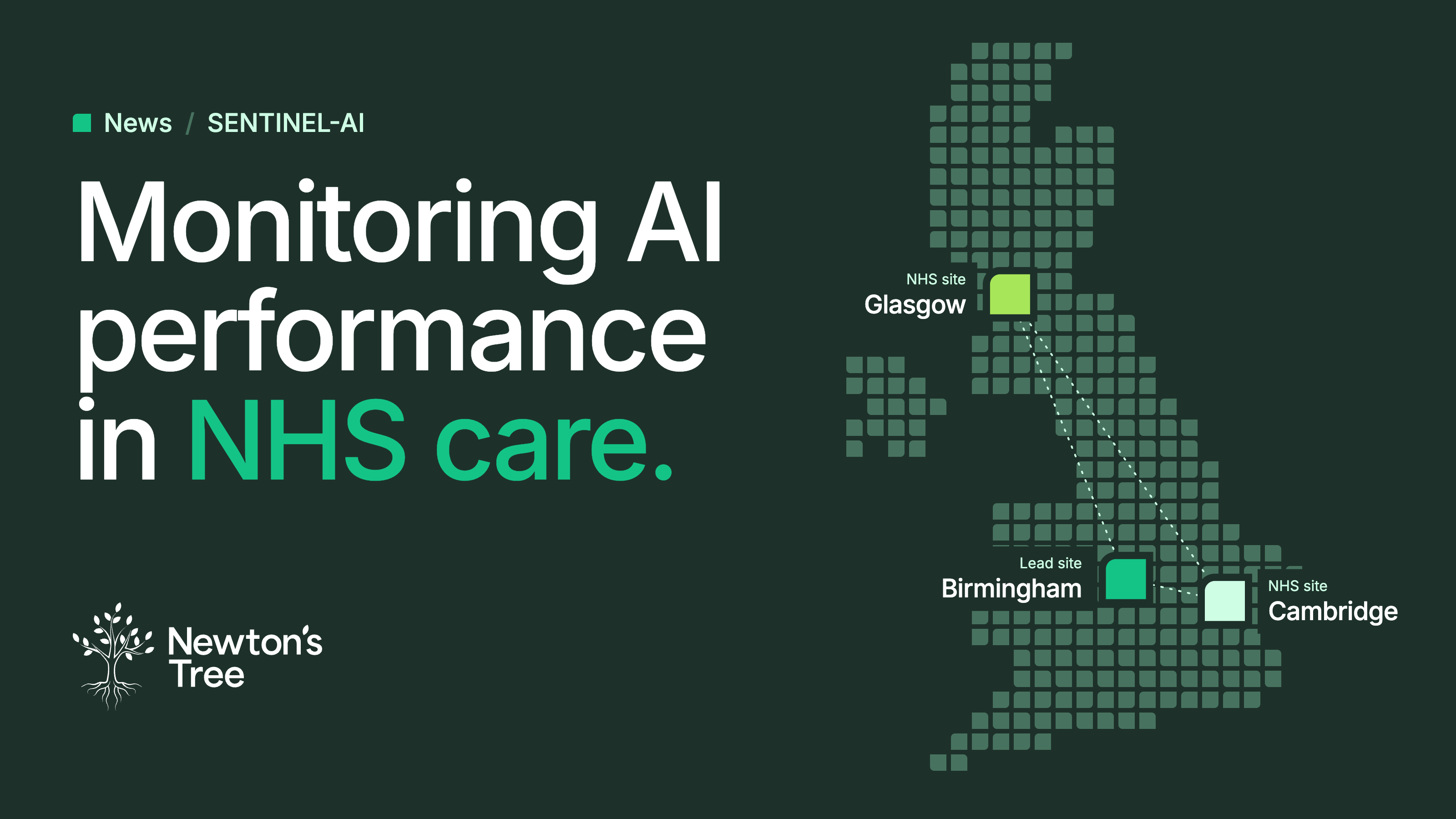
SENTINEL-AI will establish a federated framework across NHS sites in Birmingham, Glasgow and Cambridge, allowing organisations to generate and compare evidence on AI performance without transferring patient-level data between organisations. Only aggregated results, checked by NHS staff to protect patient privacy, will be shared, protecting patient confidentiality while enabling insights to be generated across healthcare settings.

‍

Who is involved

SENTINEL-AI is supported by the Health Data Research Service (HDRS) and delivered through a collaboration involving the West Midlands Secure Data Environment, hosted by University Hospitals Birmingham NHS Foundation Trust, NHS Greater Glasgow and Clyde, Cambridge University Hospitals NHS Foundation Trust, Centre of Excellence for Regulatory Science and Innovation in AI and Digital Health (CERSI-AI) and Newton's Tree.

The West Midlands SDE will lead the project, working with NHS Greater Glasgow and Clyde and Cambridge University Hospitals to demonstrate how the framework can operate across different NHS environments.

CERSI-AI will contribute expertise in regulatory science, supporting the development of robust evaluation methodologies, monitoring standards and approaches to generating evidence throughout the AI lifecycle.

Newton's Tree will provide the technical platform and expertise to deploy, integrate, monitor and evaluate AI technologies, supporting the operation of the framework across participating NHS environments.

‍

What the project leads say

"As AI becomes part of everyday NHS care, we need to know it keeps working safely and fairly for every patient, not just when it is first tested. The West Midlands SDE has the secure infrastructure and expertise to lead this work, and together with our partners we can build an approach that all NHS patients can benefit from."
Professor Simon Ball, Senior Responsible Officer at the West Midlands SDE
"UHB is proud to be leading this important national initiative. The project reflects Birmingham's growing reputation as a centre for research, data and innovation, and our commitment to ensuring new technologies are adopted safely and effectively for the benefit of patients across the NHS."
Professor Kiran Patel, Chief Medical Officer at UHB

Starting with chest X-ray AI

The project will first focus on AI tools used to interpret chest X-rays, including technologies designed to identify normal scans and support lung cancer detection. Researchers will assess how reliably different products perform across healthcare settings and patient populations, while also exploring their impact on reporting times and clinical workflows.

A key ambition of SENTINEL-AI is to create a reusable framework for AI oversight that can be adopted across the NHS, reducing the need for individual organisations to develop their own evaluation and monitoring processes and establishing a national standard for AI regulation.

While the initial focus is chest X-ray AI, the approach is being designed to support a range of future applications, including retinal imaging, pathology and ambient voice technologies.

The project will report its findings in 2027.

NEWS
November 26, 2026

West Midlands to Lead National Project to Monitor AI Performance in NHS Care

The West Midlands Secure Data Environment (SDE), hosted by University Hospitals Birmingham (UHB), will lead a major new national project to ensure artificial intelligence (AI) technologies continue to perform safely, effectively and fairly when used in NHS patient care.

Supported by the Health Data Research Service (HDRS), the project, known as SENTINEL-AI, will develop a framework to monitor AI performance across NHS organisations, helping to ensure these technologies deliver consistent benefits for patients while keeping their data securely within the NHS.

Newton's Tree is proud to be part of the collaboration delivering SENTINEL-AI.

‍

Why ongoing monitoring matters

It is vital to ensure that the performance of AI technologies in healthcare is always appropriately monitored, particularly where they are introduced into clinical practice. AI systems can perform differently across hospitals, patient populations and clinical pathways, making ongoing evaluation essential to ensure they remain safe, effective and equitable.

SENTINEL-AI will establish a federated framework across NHS sites in Birmingham, Glasgow and Cambridge, allowing organisations to generate and compare evidence on AI performance without transferring patient-level data between organisations. Only aggregated results, checked by NHS staff to protect patient privacy, will be shared, protecting patient confidentiality while enabling insights to be generated across healthcare settings.

‍

Who is involved

SENTINEL-AI is supported by the Health Data Research Service (HDRS) and delivered through a collaboration involving the West Midlands Secure Data Environment, hosted by University Hospitals Birmingham NHS Foundation Trust, NHS Greater Glasgow and Clyde, Cambridge University Hospitals NHS Foundation Trust, Centre of Excellence for Regulatory Science and Innovation in AI and Digital Health (CERSI-AI) and Newton's Tree.

The West Midlands SDE will lead the project, working with NHS Greater Glasgow and Clyde and Cambridge University Hospitals to demonstrate how the framework can operate across different NHS environments.

CERSI-AI will contribute expertise in regulatory science, supporting the development of robust evaluation methodologies, monitoring standards and approaches to generating evidence throughout the AI lifecycle.

Newton's Tree will provide the technical platform and expertise to deploy, integrate, monitor and evaluate AI technologies, supporting the operation of the framework across participating NHS environments.

‍

What the project leads say

"As AI becomes part of everyday NHS care, we need to know it keeps working safely and fairly for every patient, not just when it is first tested. The West Midlands SDE has the secure infrastructure and expertise to lead this work, and together with our partners we can build an approach that all NHS patients can benefit from."
Professor Simon Ball, Senior Responsible Officer at the West Midlands SDE
"UHB is proud to be leading this important national initiative. The project reflects Birmingham's growing reputation as a centre for research, data and innovation, and our commitment to ensuring new technologies are adopted safely and effectively for the benefit of patients across the NHS."
Professor Kiran Patel, Chief Medical Officer at UHB

Starting with chest X-ray AI

The project will first focus on AI tools used to interpret chest X-rays, including technologies designed to identify normal scans and support lung cancer detection. Researchers will assess how reliably different products perform across healthcare settings and patient populations, while also exploring their impact on reporting times and clinical workflows.

A key ambition of SENTINEL-AI is to create a reusable framework for AI oversight that can be adopted across the NHS, reducing the need for individual organisations to develop their own evaluation and monitoring processes and establishing a national standard for AI regulation.

While the initial focus is chest X-ray AI, the approach is being designed to support a range of future applications, including retinal imaging, pathology and ambient voice technologies.

The project will report its findings in 2027.